


























Under Threat: France's Nuclear Shield — How Climate and Old Mistakes Turn Europe and Ukraine into a Powder Keg
Analytics | 29 July, 2026 at 18:03 | 2,107 | Author: Olena Zelenina
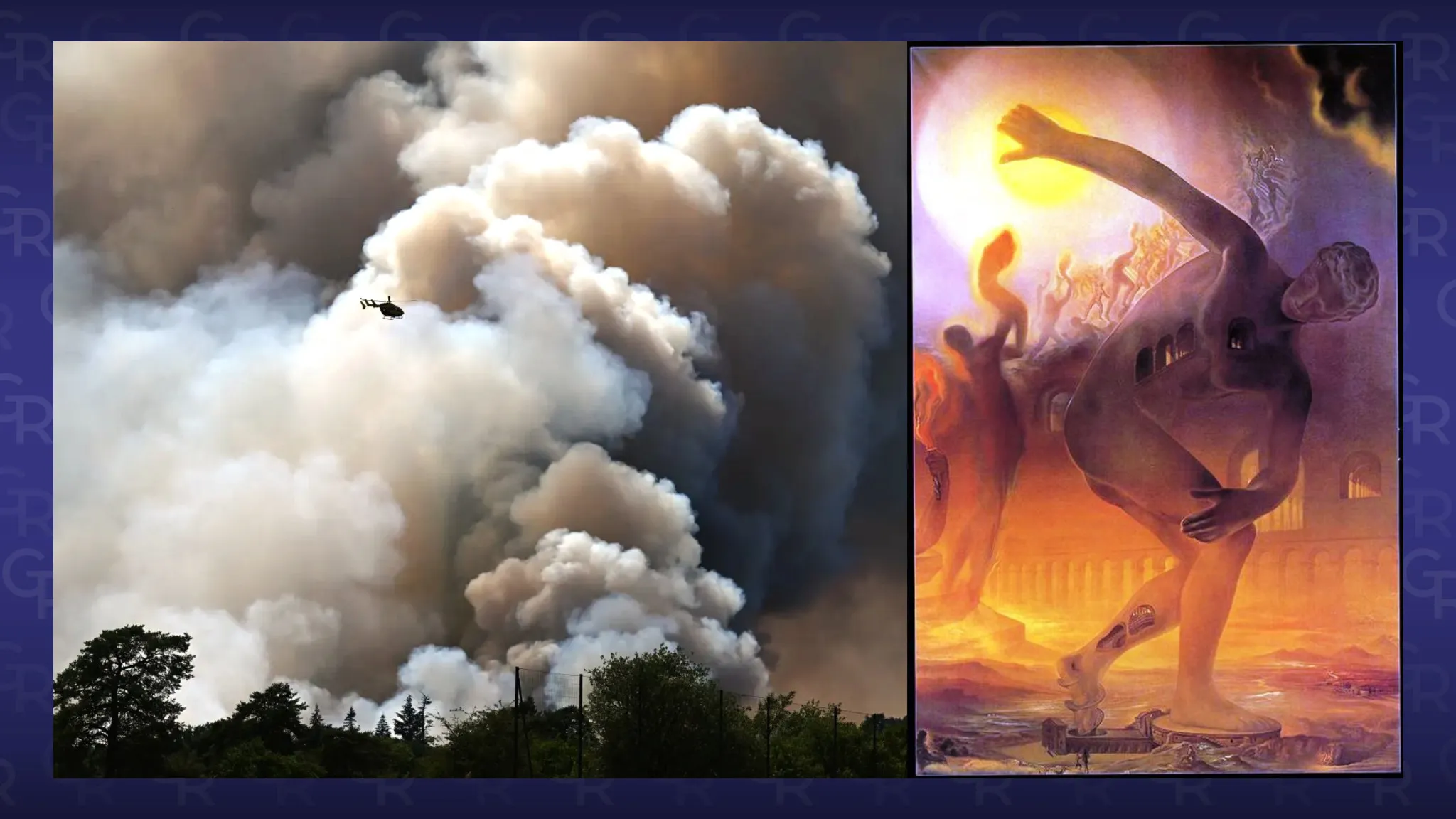
Collage by Olena Zelenina. Salvador Dalí, The Cosmic Athlete. Photo AP.
Why are water-dropping helicopters no longer saving forests? Decades of extinguishing every minor fire have turned European forests into deadwood powder kegs. And Ukraine is no exception—similar fires flared up in the Kharkiv region long before the war. What do scientists propose instead of the old tactics?
The Swiss Neue Zürcher Zeitung (NZZ) published a thorough scientific analysis of the wildfire phenomenon, which becomes a major nightmare for Europe and North America every summer. The article debunked popular myths and explained why the usual tactic of "extinguishing at any cost" no longer works.
Scientists emphasize: a large-scale fire requires three components—fuel (dry biomass), oxygen, and an ignition source. Due to prolonged heat waves and droughts caused by climate change, the moisture content of wood and soil drops to critical levels, turning an ordinary forest into a real powder keg that can be set ablaze by even the smallest spark.
An interesting conclusion of the researchers: the absolute suppression of all minor fires without exception over decades has played a cruel trick on foresters. A huge amount of dead dry wood accumulates in the forests. When such a "neglected" forest catches fire, the blaze becomes uncontrollable—a so-called crown fire, or canopy fire, which is virtually impossible to extinguish by conventional methods.
NZZ notes that dropping water on fires from helicopters is merely treating the symptom.
The new scientific approach requires:
Prescribed burning—controlled burning of dry brush in winter or spring;
Changing forest composition—abandoning monoculture pine plantations in favor of deciduous and mixed forests, which burn significantly worse;
- Creating natural buffer zones around populated areas.
Slobozhanshchyna Mirror:
why NZZ's systemic conclusions
are painful for the Kharkiv region
The paradoxes described by Swiss researchers are not theoretical futurology for Ukraine and specifically for the Kharkiv region, but a long-standing and systematic pain.
If we leave aside the factor of war and deliberate shelling, Ukrainian forests have been destroyed for years by this very traditional man-made trap: a combination of monoculture pine plantations and outdated forest management approaches.
A vivid historical example is the large-scale natural disaster in August 2008 in the Izyum area (specifically in the Prydonetske forestry area). At that time, due to extreme heat and negligence, fire instantly engulfed about 900 hectares of dry pine tracts. The fire quickly spread to the treetops—resulting in the exact crown fire that NZZ analysts write about, where the firestorm moves at wind speed, and conventional firefighting equipment becomes virtually powerless.
Extinguishing that hell required the deployment of firefighting aircraft, hundreds of rescuers, and heavy machinery.
Why did it happen then,
and why did it regularly recur in peacetime years?
Pine monocultures. A significant portion of the Kharkiv region's forest stock consists of dense pine tracts artificially planted during Soviet times on sandy soils. Pine contains resin, and its dry needle litter turns into an ideal detonator.
Lack of diversity and firebreaks. The absence of deciduous buffer zones within pine tracts allows fire to cover tens of kilometers unimpeded.
Accumulation of deadwood. The ban on or lack of practice of controlled burning and sanitary clearing of brushwood leads to tons of dry biomass accumulating under the canopy for years.
The weather warns:
the respite is ending
Today, this analysis is as relevant as ever. Cool and relatively humid days in Ukraine are coming to an end—meteorologists predict the return of persistent heat and high temperatures.
As temperatures rise, the fire hazard level in the forest tracts of the Kharkiv region and other areas rapidly soars to the critical Category V. In conditions where climate change makes each summer drier than the last, ignoring the scientific recommendations of European researchers regarding structural changes to forests and preventive deadwood management is a conscious risk of planting another time bomb beneath our own environmental safety.
And in the meantime:
alarming reports from Europe
While scientists search for systemic solutions, Southern Europe is already experiencing a true fire hell right now. A new wave of extreme heat with temperatures over +40 °C has turned the forest tracts of Spain and France into burning traps.
Spain under attack by a wall of fire: The country has recorded the largest wildfires in its history. The fire has burned over 150,000 hectares. Huge tracts are burning in the province of Ávila and near Madrid; authorities are declaring states of emergency and urgently evacuating entire towns.
France in a race against time: In the Gironde region (west of Bordeaux), the largest wildfire since World War II is raging. The fire has engulfed over 40,000 hectares of pine forests and come right up to the suburbs of Bordeaux.
Mass evacuations: In total across both countries, over 330,000 people—local residents and tourists—were forced to urgently leave their homes, campsites, and hotels due to the threat of smoke poisoning and a solid wall of fire.
These facts are yet another clear confirmation: if approaches to forest management are not changed immediately, climate change will turn forest tracts into a disaster every summer.
More than just a forest:
France's nuclear shield under threat
A clear proof that wildfires have become a top-tier national security threat is the events in the Bordeaux area (Gironde department). There, the firestorm came right up to critical defense facilities.
French authorities were forced to urgently halt operations and evacuate personnel from the ArianeGroup plant in Saint-Médard-en-Jalles—the facility responsible for producing solid fuel for M51 ballistic missiles, which form the backbone of French nuclear deterrence.
In addition, at the request of the military, sensitive equipment was partially removed from Dassault Aviation plants, where Rafale fighters are produced, and the perimeter around the classified research complex of the Atomic Energy Commission (CEA) was secured. To save strategic enterprises and warehouses, military engineers worked day and night cutting wide buffer lanes through the dry pine forest burning all around.

Comments
Some more relevant news for now