

Miracle of Wrocław: Scythemen, Javelins, and Prayer Before Battle
Blogs | 19 September, 2026 at 20:25 | 1,067 | Author: Olena Zelenina
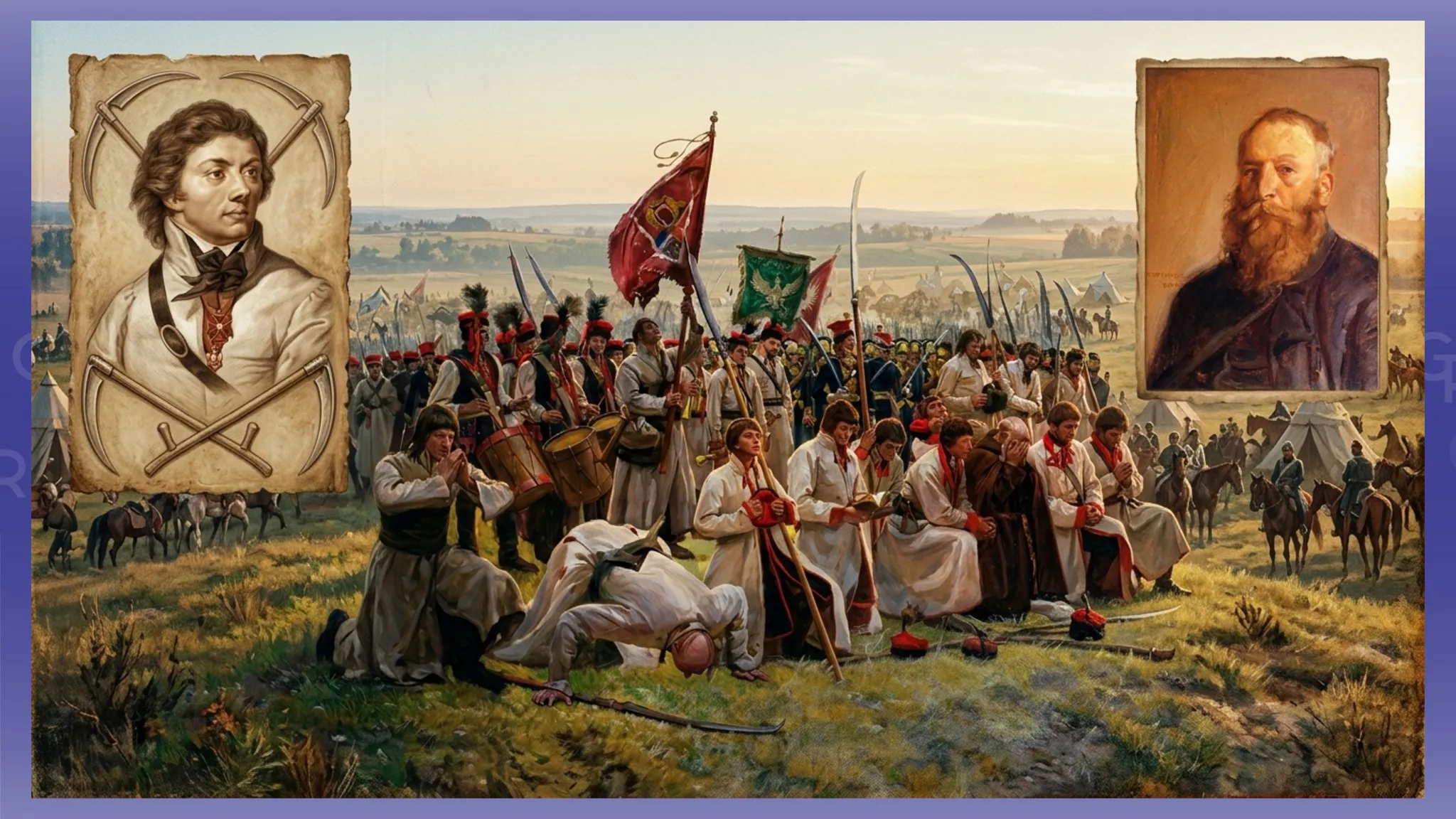
Collage by Olena Zelenina.
Saturday morning, the quiet of an art gallery, and a painting that is hard to take your eyes off. Before me is "Prayer Before the Battle of Racławice" by Józef Chełmoński (1849–1914), a monumental canvas that makes the heart squeeze with a strange sense of familiarity.
Look closely at these faces on the canvas — Chełmoński completely abandoned pathos. Instead of idealized warriors, he depicted simple peasants, exhausted by hard labor, with stern and weather-beaten faces.
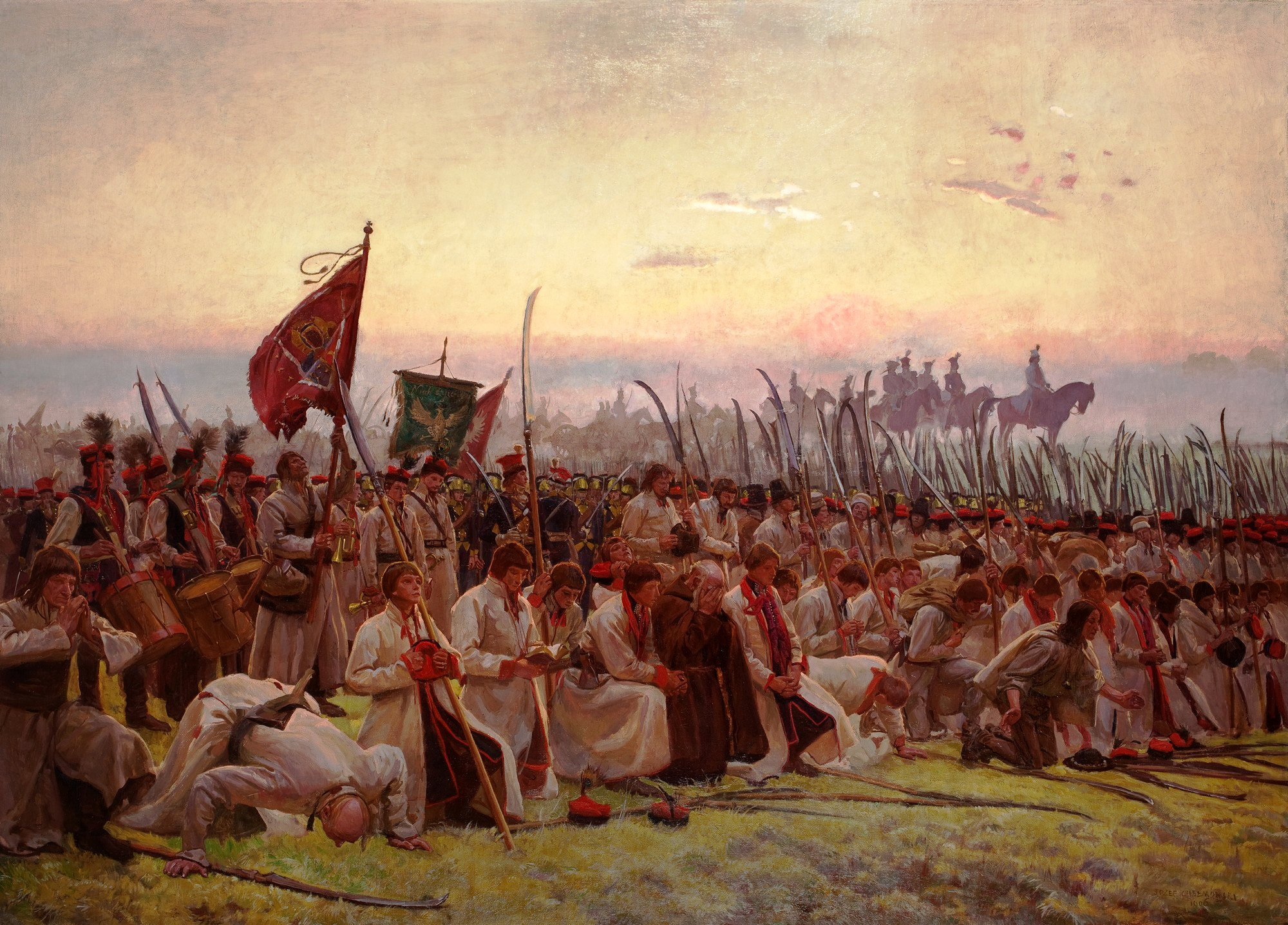
Painting by Józef Chełmoński "Prayer Before the Battle of Racławice" (1906) at the National Museum in Wrocław. Photo by the author.
There is no panic here, but there is no feigned heroism either. In pressed lips and lowered gazes, one reads a deep, almost fatalistic humility with one's own fate and a natural human fear of death.
However, this prayer is not about weakness. Look at how people lean on their scythes and silently overcome this fear.
Through the tilt of a head, tightly joined palms of a man who in repentance has completely prostrated himself on the damp earth, the artist conveys an extraordinary inner transformation. In this silence, they turn their fear into a quiet, steel-like determination, and from a collective of ordinary tillers, they become a single national force.
Unable to Escape Anxious Parallels
Standing before this canvas today, I cannot escape anxious parallels with our present.
The modern world is raging again, and our country is living through its own bloody and majestic stage of struggle for existence.
How many times during these years have we seen similar pictures in real life? Yesterday's teachers, programmers, farmers, and builders put aside their usual tools of trade to take up arms.
They likewise kneel in the damp grass of Ukrainian fields, quietly praying before a decisive battle, seeking spiritual support and light among the utter darkness of war.
This quiet prayer in Chełmoński's painting tells us the main thing: the highest strength and resilience are born not from despair or rage, but from deep faith in one's truth and love for one's native land.
Between Pastoral Calm and Life Drive
Looking at Chełmoński's work, I have always felt a special emotional duality in him.
On the one hand, he is a landscape painter in love with tranquility, who extraordinarily delicately feels the pastoral silence of the evening steppe, the boundlessness of Polish and Ukrainian landscapes.
On the other, he is an artist captivated by unstoppable movement, creating almost wild scenes with troikas and four-in-hands of horses rushing at a gallop, tearing through space.
It seems to me that in this lay the deep internal contradiction of the artist himself — an eternal oscillation between a passionate desire for comfort, peace, and a thirst for a stormy, irrepressible life drive.
Ukrainian Paradise and Source of Inspiration
Ukraine was a special great love of Chełmoński. It became a real source of inspiration and a painterly paradise for him.
From the late sixties and for almost forty years in a row, he regularly came to our lands.
His routes lay through Right-Bank Ukraine, Podolia, Volhynia, Kyiv region, Polesia, and Zaporizhzhia.
The artist literally lived through these journeys, observing steppe expanses, hamlets, local life, and graceful horses for hours.
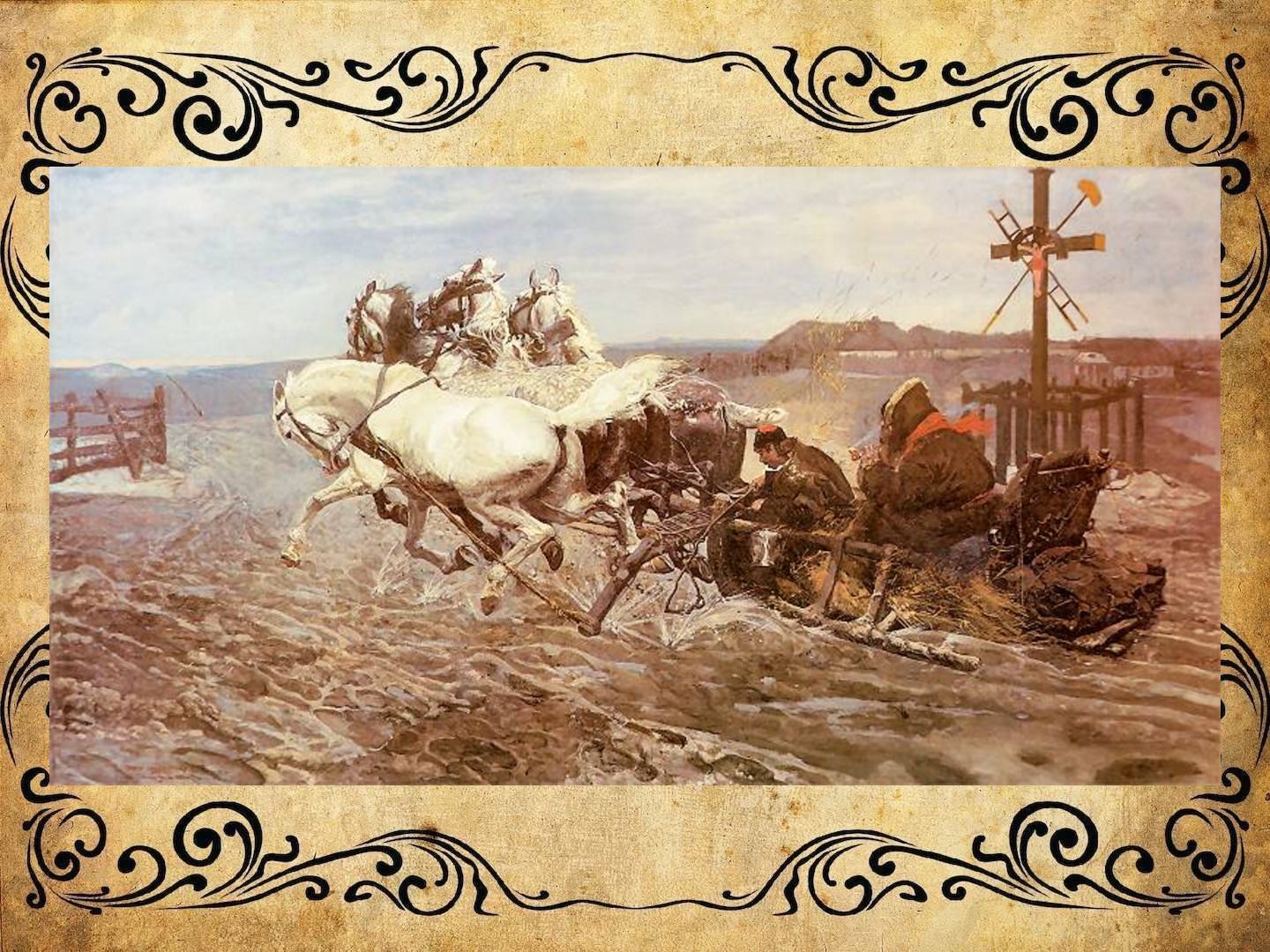
Józef Chełmoński. "Memory of a Trip to Ukraine" (1877). Private collection.
In his famous cycle "Ukrainiana" — from "Winter Night in Ukraine" to "Memory of a Trip to Ukraine" — a sincere admiration for our nature and that special "homeliness" that he felt so deeply and kept in his heart was embodied.
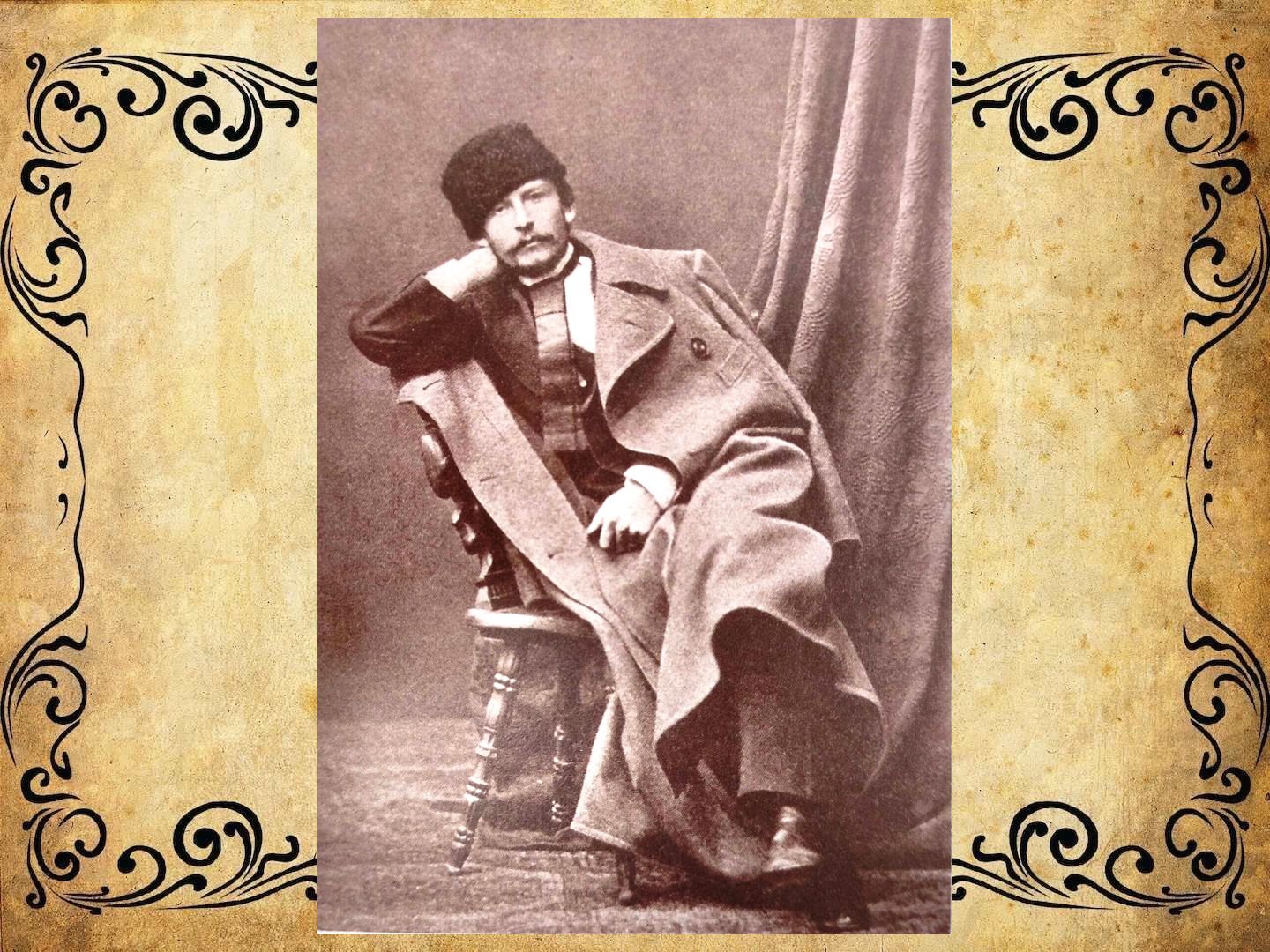
Józef Chełmoński. 1874. In the photograph, the young Chełmoński is depicted in his characteristic, extravagant style for that time. As contemporaries recalled, the artist loved to shock the public with his authentic wardrobe, combining elements of traditional clothing (including Ukrainian motifs that he grew to love during his trips to Ukraine) with elements of travel overcoats, caps, or papakhas. Public domain.
Involuntarily, one thinks: why do politicians orchestrate speculations on hostility when there is so much in common, truly heroic, beautiful, and soulful between the Polish and Ukrainian peoples? And most importantly — why? If you compare interests, there are more shared interests than grievances and contradictions...
Anticipation of Revolution
and an Explosion of Resentment
But the painting with the prayer is a completely different dimension of his artistic world. It surprises and even shocks.
Chełmoński, who had always avoided loud historical subjects and willingly painted open spaces, suddenly writes a grandiose multi-figure composition.
Where does this desire to gather so many people together come from?
The answer is suggested by time. The artist worked on the canvas when the empire was shaken by revolutionary events. It is an explosion of historical resentment, an anticipation of inevitable changes, and at the same time a sincere prayer for them — an appeal to God for higher support at the moment when the old reality is cracking at the seams.
Chełmoński captured the minute before the battle when ordinary peasants drop to their knees in the damp spring grass.
In their hands are ordinary scythes forged into sharp pikes. A forest of these vertical blades frightens and fascinates at the same time.
Simple peasant scythemen cross their inner Rubicon. They overcome the fear of death not at the moment of a fierce attack, but right here, in a silent penitential prayer, transforming from disenfranchised tillers into a powerful national force capable of repelling the empire.
Riders in the Fog
In the background, in a light haze near the very horizon, Chełmoński leaves a barely noticeable but extremely important detail — the silhouettes of horsemen. This is Tadeusz Kościuszko with his staff and officers of the regular army.
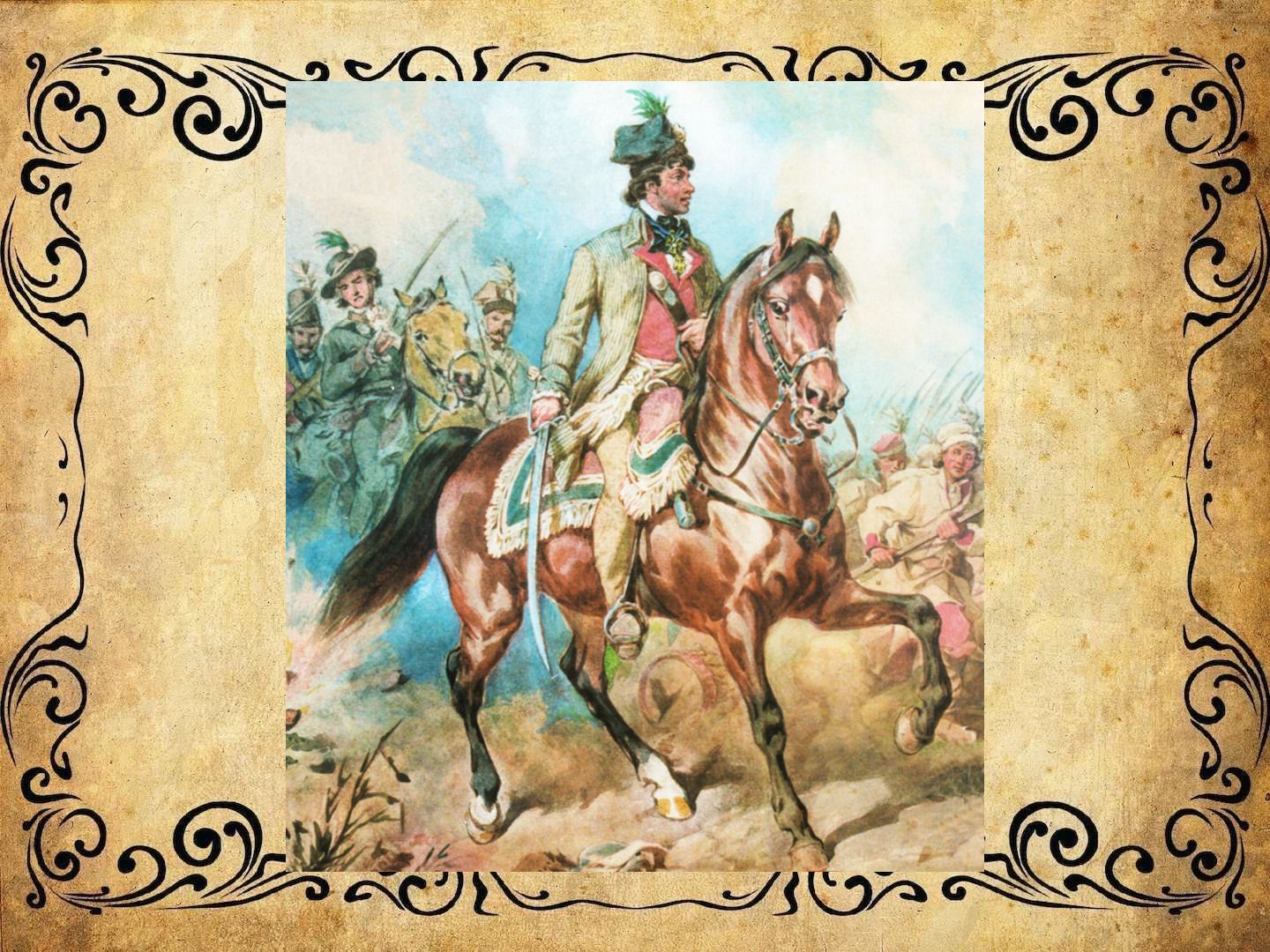
Kościuszko at Racławice (artist Juliusz Kossak. 1899). Public domain.
A deep meaning lies in this compositional solution. In the foreground are the people who, in these minutes, realize themselves as a true nation. And Kościuszko's riders in the background are a symbol of statehood, legitimate force, and the continuity of military tradition.
A strange feeling arises: neither the peasants with scythes nor the command on horses are alone in this decisive moment. They are a single whole. Here, the regular state army and the popular movement merge into one powerful monolith. It is precisely this unity of ordinary people and state will that transforms an ordinary battle into a sacred struggle for freedom.
The Commander Who Outplayed the Empire
The figure of Tadeusz Kościuszko himself in the background adds a special drama to the story.
For St. Petersburg, this general was the most dangerous enemy, because it was he who dared to take a radical step — with the Połaniec Proclamation, he granted freedom to the peasants to turn noble resistance into a nation-wide war. Catherine II threw her best forces against him, and after a severe wound at Maciejowice, Kościuszko ended up in Russian captivity.
Then came an extraordinary political game of chess with the empire. The new Tsar, Paul I, personally visited him in the Peter and Paul Fortress and offered freedom in exchange for an oath. Kościuszko went to this forced compromise, but put forward a tough requirement: together with him, the Tsar must release 20,000 captured fellow rebels. Paul I agreed. However, as soon as he found himself abroad, the general immediately returned the money to the Tsar and annulled the oath as made under duress.
Later, Alexander I tried to bribe the general's authority, offering him to lead a Russian-controlled Poland.
But Kościuszko put forward unbearable conditions for the empire: the abolition of serfdom and the return of all seized lands. Having received a refusal, he chose emigration, but did not take a single step in favor of the enemy. And on Chełmoński's canvas we see precisely this kind of Kościuszko — an unyielding leader for whom the fate of his own people was always higher than his own freedom and any political bargaining with the occupiers.
The Path from Lviv to Wrocław:
How Did Prayer Save the Painting?
The fate of the canvas itself turned out to be no less dramatic than its subject. In 1912, the painting was bought for huge money for the Lviv Art Gallery, where it was stored for decades.
"Self-Portrait" (1902) by Józef Chełmoński. Stored in the collection of the National Museum in Warsaw.
But World War II came. In the flames of thirty-nine and the subsequent chaos, the masterpiece, along with part of the Galician collections, ended up in Warsaw — in the very hell of military actions.
The painting survived severe air raids, bombings, and the destructive Warsaw Uprising.
Watching whole blocks ruin, priceless monuments burn to the ground nearby, one involuntarily thinks: was it not that very quiet prayer from the canvas that saved it from destruction?
The masterpiece miraculously survived in this catastrophe, after the war it got to Wrocław, spent years on deposit, and only in the early eighties officially became part of the collection of the Wrocław National Museum.
And no matter how many centuries pass, the moment before a decisive step toward freedom always looks the same — like a quiet, but steel-strong conversation between a human and God.

Comments
Some more relevant news for now