
Anthem, Poisoned Arrow, and the Ghost of Empire: What Is Hidden Within Józef Brandt’s Masterpiece Bogurodzica?
Blogs | 12 September, 2026 at 18:50 | 1,090 | Author: Olena Zelenina
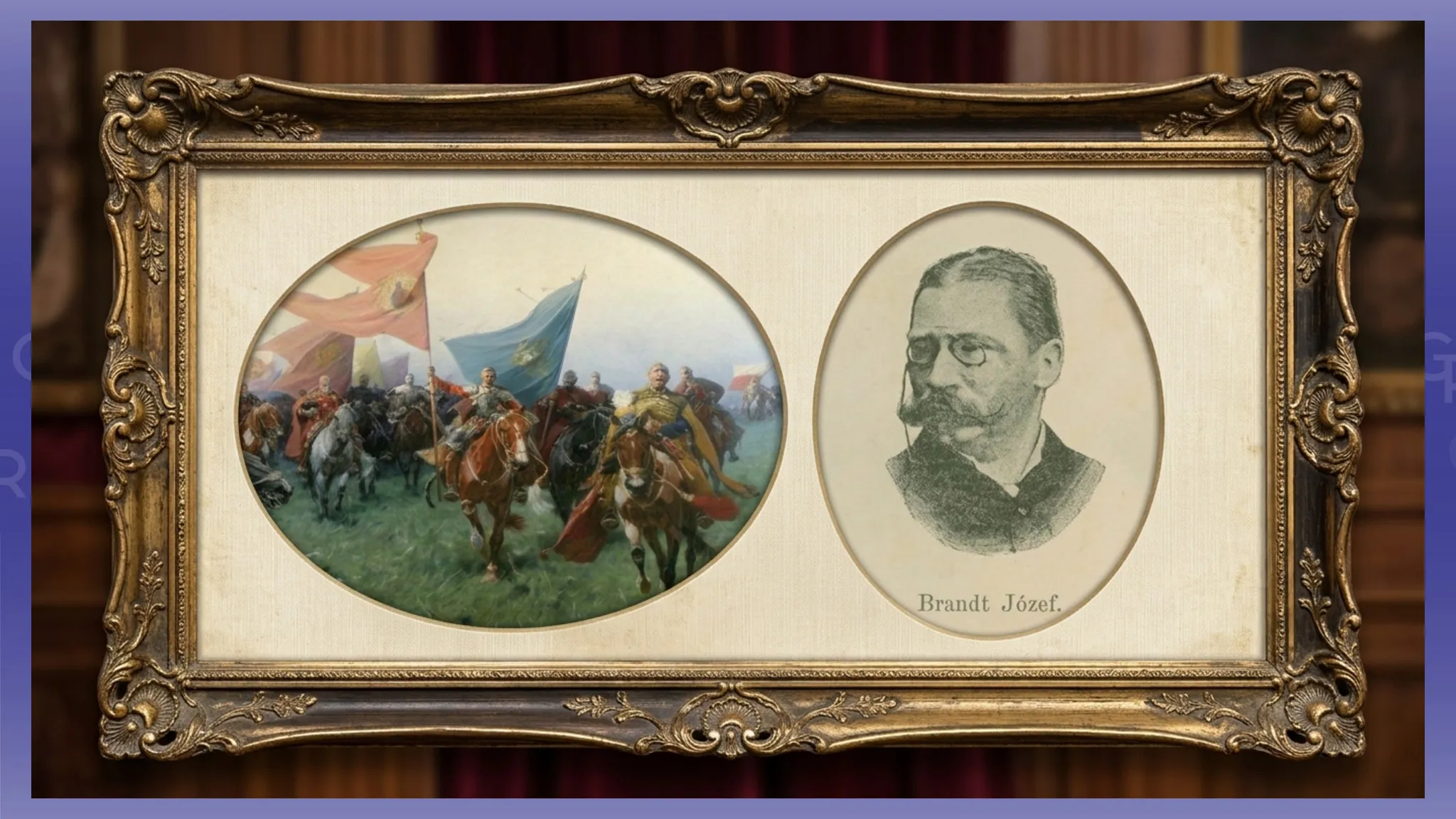
Collage by Olena Zelenina.
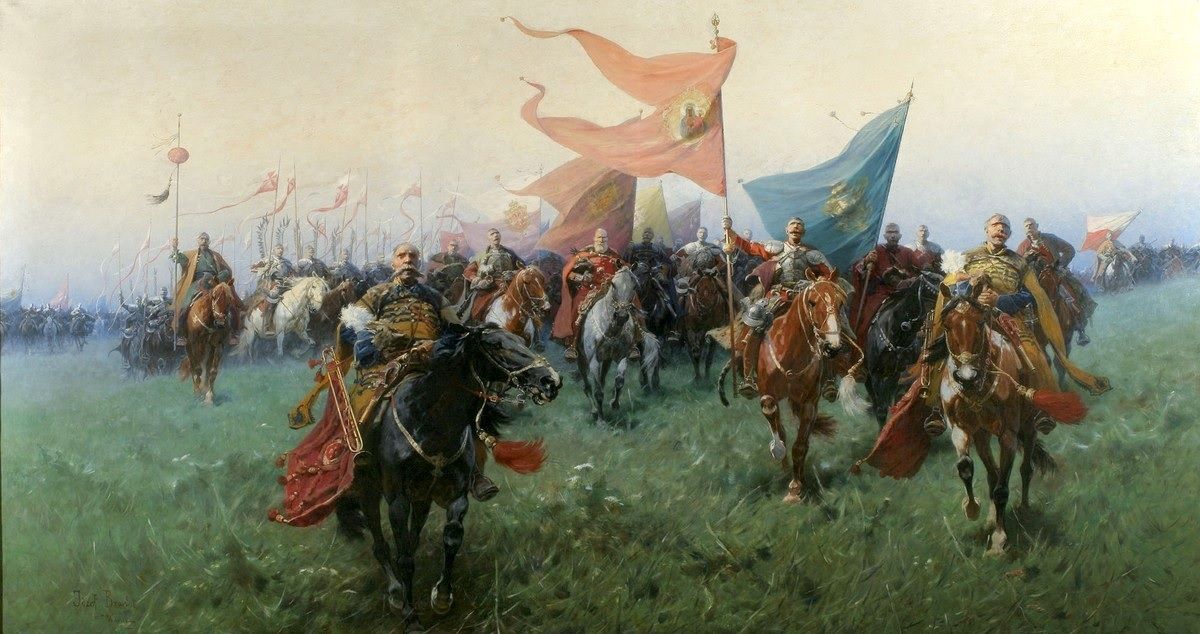
Standing before this epic painting, which is a true gem of the collection at the National Museum in Wrocław, one feels not just artistic mastery emanating from it, but almost the physical resonance of a polyphonic choir.
Józef Brandt created Bogurodzica in 1909 — at a time when the Russian Empire, torn apart by the aftermath of the first revolution, was bursting at the seams and attempting to maintain its decaying order through harsh reaction. In this grim period of twilight for the imperial regime, the artist turned to the 1621 epic, returning to society the memory of a time when a united force shattered an invading onslaught.
Gromada Background Note
The Polish artist Józef Brandt (1841–1915) is often called the poet of the Ukrainian steppes and Cossackdom. He created mostly battle scenes set against the backdrop of Cossack-Tatar battles and the 17th-century war with the Swedes. Józef Brandt had a profound influence on Polish painting and literature, notably inspiring Henryk Sienkiewicz to write his famous trilogy With Fire and Sword.
Anthem Instead of a Battle Cry and the Fateful White Horse
The title of the canvas — Bogurodzica — is the key to the entire composition. It refers to the oldest Polish religious hymn, which for centuries served warriors as both a prayer and a battle march.
According to legend, this very hymn was sung at Grunwald, and it is this song that echoes over the field on the eve of the Battle of Khotyn. On the canvas, the horsemen are frozen in a single impulse: their faces are stern, their gazes turned toward the sky, and in the center of the formation flies a massive battle banner bearing the image of the Virgin Mary.
In the center of the composition, in the middle ground atop a white horse, Brandt depicted the Grand Hetman of Lithuania, Jan Karol Chodkiewicz (1560–1621). He led the overall defense, but being gravely ill, he passed away directly in the military camp at the height of the exhausting siege.
The Dramatic Price of Victory:
Sagaydachny’s Final Shot
Alongside the regular Crown forces — the hussars and armored companions (towarzysze pancerni) — the Zaporozhian Cossacks played a decisive role in this battle.
Hetman Petro Sagaydachny brought about 40,000 Cossacks to Khotyn, which constituted more than half of the entire Christian army. Without this reinforcement, the 30,000-strong Polish-Lithuanian army simply would not have held out against the 100,000-strong Ottoman army of Sultan Osman II.
The Cossacks bore the brunt of the enemy’s fiercest assaults, while night counterattacks led by Sagaydachny ultimately exhausted the Turkish forces and compelled them to sign a peace treaty.
For Sagaydachny himself, this victory proved fatal. In one of the fiercest clashes, he was wounded by a poisoned arrow — a bitter irony for a master of the bow, whose surname derives from the word sahaydak (quiver).
The poison acted slowly, causing severe sepsis. Polish King Sigismund III even dispatched his own personal physician, but the medicine of the era proved powerless.
Already terminally ill, the Hetman returned to Kyiv in a special carriage, where until his final days he managed affairs: he willed his estate to the Kyiv, Lviv, and Lutsk Brotherhood schools and to the restoration of monasteries. On April 10, 1622, the outstanding commander passed away and was buried at the Kyiv Brotherhood Monastery.
The Artist Among Warriors:
A Self-Portrait as Confession?
The master deliberately made the faces of the warriors on the canvas resemble one another, with their lips open in unison as they sing. He sacrificed portrait individuality for the sake of epic scale, transforming the cavalrymen into a single monumental force.
Comparing Józef Brandt’s self-portrait with the faces of the warriors in the foreground of Bogurodzica, your author finds it hard not to notice a striking, almost mystical resemblance.
Look at the characteristic features of Brandt himself in his mature years: a high, prominent forehead and receding hairline; dignified, thick gray moustaches; an oval face shape, a strong chin, and deep-set, attentive eyes.
Now look at the key figures in the painting! The rider in the foreground on the left (on the dark horse): that same forehead, those distinctive moustaches, the contours of the face — it is literally a portrait of an elderly Brandt dressed in a zhupan! The rider on the right (in the golden zhupan): again, those exact same familiar features.
This is far from accidental; it is a well-known technique in classical painting. Many great masters (from Velázquez to Rembrandt and Matejko) incorporated their own features into large historical canvases.
Painted in 1909, when Brandt was over 60, Bogurodzica became his crowning, most monumental work.
By bestowing his own features upon the warriors, the 70-year-old artist literally "joins the ranks" alongside his heroes, associating himself with that era and its spiritual power.
Symbolism of the Sacred Banners
I see a crimson-red banner in the center (bearing the image of the Virgin Mary): what is it? This is the main sacred battle banner (khoruhva). Crimson and red were traditionally the primary colors for both the Crown forces and the Ukrainian Cossacks (the crimson banner being a classic symbol of the Zaporozhian Host).
Why is it in front? It depicts the Virgin Mary (Hodegetria/Oranta), which directly explains the title of the painting. It is under this holy image that the army unites in common prayer. Brandt brings it to the foreground as the spiritual center of the entire army, rather than just a specific branch of service.
What is that mysterious blue banner on the right? The blue (azure) color with a gold or silver emblem/image (a heraldic symbol in a golden radiance stands out on Brandt’s banner) is the banner of the Grand Duchy of Lithuania or the personal hetman banner of Jan Karol Chodkiewicz (who was precisely the Grand Hetman of Lithuania).
Additionally, blue with gold elements (stars, a cross, or an image) was very common among Cossack regimental banners and noble mercenary units (particularly from Ruthenian/Ukrainian lands, where blue and yellow/gold traditionally had deep roots).
Placing the blue and crimson banners side by side highlights the main military leaders and elite units leading the entire cavalry force.
Why are there white-and-red flags in the background? The white-and-red colors (as well as the pennants on the long hussar lances) represent the official state symbolism of the Kingdom of Poland. They wave on the left and deeper in the composition over the disciplined ranks of winged hussars.
Brandt builds depth in the frame: in the foreground are the vanguard, the command, Cossack elements, and sacred banners, followed by the hussar army deployed in line under Polish and Crown banners, stretching all the way to the horizon.
Such a distribution of flags clearly demonstrates that at Khotyn fought not a monolithic, homogeneous mass, but a complex, diverse allied army — Crown nobility, Lithuanian detachments, and Cossack regiments, united under a single crimson banner with the image of the Virgin Mary.
One Voice for All:
When Old Grievances Are Forgotten
In 1596, the young captain Jan Karol Chodkiewicz, as part of Stanisław Żółkiewski’s army, took an active part in suppressing the uprising of Severyn Nalyvaiko (specifically during the battles near Bila Tserkva and the tragic siege at the Solonytsia River near Lubny).
Yet just 25 years later, in 1621, that same Chodkiewicz (now the Grand Hetman of Lithuania) and Ukrainian Cossacks led by Petro Sagaydachny stood side by side in the Khotyn camp against a 100,000-strong Turkish army.
One involuntarily wonders: how does this correlate, and how can it be understood?
During Nalyvaiko’s uprising (1596), the Crown authorities viewed the Cossacks as "willful people" or outlaws. But over a quarter of a century, thanks to the subtle diplomacy and reforms of Petro Konashevych-Sagaydachny, Zaporozhian Cossackdom transformed into a disciplined, professional, and autonomous army, without which the Polish-Lithuanian Commonwealth simply could no longer defend its borders.
The nobleman Chodkiewicz was a professional military man ("enamored with the hussars" and military art). Sagaydachny’s Cossacks were professional masters of war (infantry and experts in night attacks). Despite the bloody past of 1596, in the Khotyn camp Chodkiewicz openly acknowledged that it was Cossack steadfastness holding the camp, while Sagaydachny respected Chodkiewicz as an experienced supreme commander.
Sagaydachny presented King Sigismund III with clear political demands for participating in the Khotyn War: the repeal of restrictions on Cossacks, recognition of the rights of the Orthodox Church, and the legalization of the Cossack estate. Chodkiewicz and the nobility were forced to accept the Cossacks as equal partners on the battlefield.
In 1621, the Khotyn War posed an external existential threat to the entire region. Had the Ottoman Empire breached Khotyn, it would have destroyed the Polish-Lithuanian Commonwealth and endangered Ukraine itself. Faced with total destruction, former bitter enemies were forced to become allies.
That is why this plot resonates so powerfully with the present day. The painting reminds us of a simple truth: in the face of a threat from the East, the decisive factor is a shared voice and the tempered unity of peoples standing shoulder to shoulder for their freedom.
Józef Brandt painted Bogurodzica in 1909, possessing a deep knowledge of the history of the Polish-Lithuanian Commonwealth.
For him, this canvas is an artistic manifesto stating that the greatest victories are achieved when a nation is capable of stepping over past internal strife for the sake of a shared higher goal.
Chodkiewicz and the Cossacks in the painting, singing the single hymn-prayer Bogurodzica together, represent symbolic forgiveness and unification to save a common home.
More illustrations in the Ukrainian original.

Comments
Some more relevant news for now